
Virtual height: why source design shows up in your uniformity.
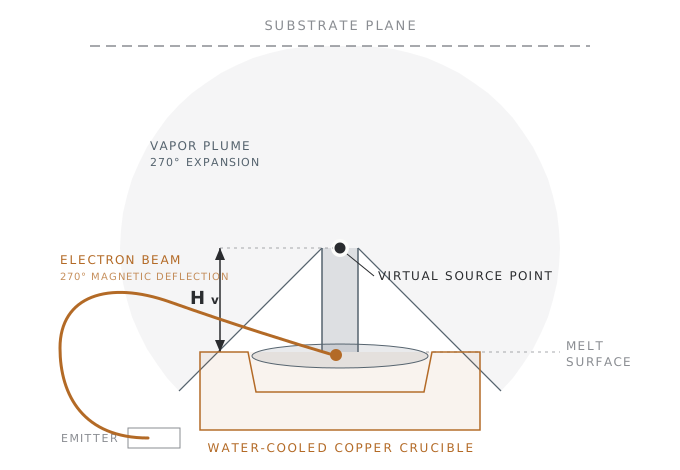
When you evaporate from an e-beam source, the vapor doesn't behave as if it leaves the melt surface. It behaves as if it originates from a point a short distance above it — the virtual source height, Hv.
What sets Hv: melt-pool geometry, the beam sweep pattern, pool depth, vapor collisions near the source, pocket shape, and how the material wets.
Why it matters to your coating
- Thickness uniformity is calculated from the virtual source location — not the crucible.
- A higher Hv puts the apparent source closer to the substrate: broader distribution, better edge coverage. A lower Hv is more directional: higher center thickness, lower edge.
- Tooling factors depend on it. Veeco, Temescal, and Kurt J. Lesker calculations all use a specified virtual source height, not the physical crucible location.
- Shadowing: on deep pockets, optical mounts, MEMS, and tall fixtures, Hv determines which surfaces the vapor stream can actually reach.
A quick example: melt surface at 0, Hv at +4 inches, substrate 24 inches above the source — your software treats the throw as 24 − 4 = 20 inches, which changes deposition rate, tooling factor, and uniformity.
Typical virtual heights: a small 4-pocket source runs 1–3 inches; a 6–10 kW source, 2–6 inches; large optical coaters, 4–12 inches. Swept rectangular pools are determined experimentally.
Here's the point for choosing a source: steady magnetics, steady cooling, and a controlled pocket and sweep give you a predictable virtual height — and a predictable virtual height is what makes your uniformity repeatable. That's a concrete reason the design of the source shows up in your results.
Spec a source for your process
Tell us your fixture geometry and materials — we'll help match the source and virtual height.